So here we are. Two days before the end of 2020. Needless to say 2020 through a wrench into–well, itself–and that has meant I’ve spent less time blogging in order to focus elsewhere. The goal wasn’t to abandon blogging all together, but to write it when I had the sufficient time to do so. I tried my best to keep up, really. But remote spring learning led into summer prep for Fall. The Fall semester was focused on building a fully asynchronous online version of Intro to Ad as an overload course (more on that in a future post). In addition, the Office of Digital Learning has been feverishly working to support a new initiative called OU Online by assisting faculty in the design and development of four online programs this Fall with four more slated to launch next month. This has meant a handful of hires and growth inflections, which have come with the additional wrinkle of the office being fully remote since March.
So it goes without saying that I’ve been–that the world’s been–a tad busy. This led to me starting a new list on Clear a few months ago that contained all the posts I would have written this year but failed to do so. So here I am attempting to play a bit of catch up in the downtime between semesters. The family has rented a cabin near Beavers Bend State Park, a place which is slowly becoming our home away home after I first visit exactly three years ago.
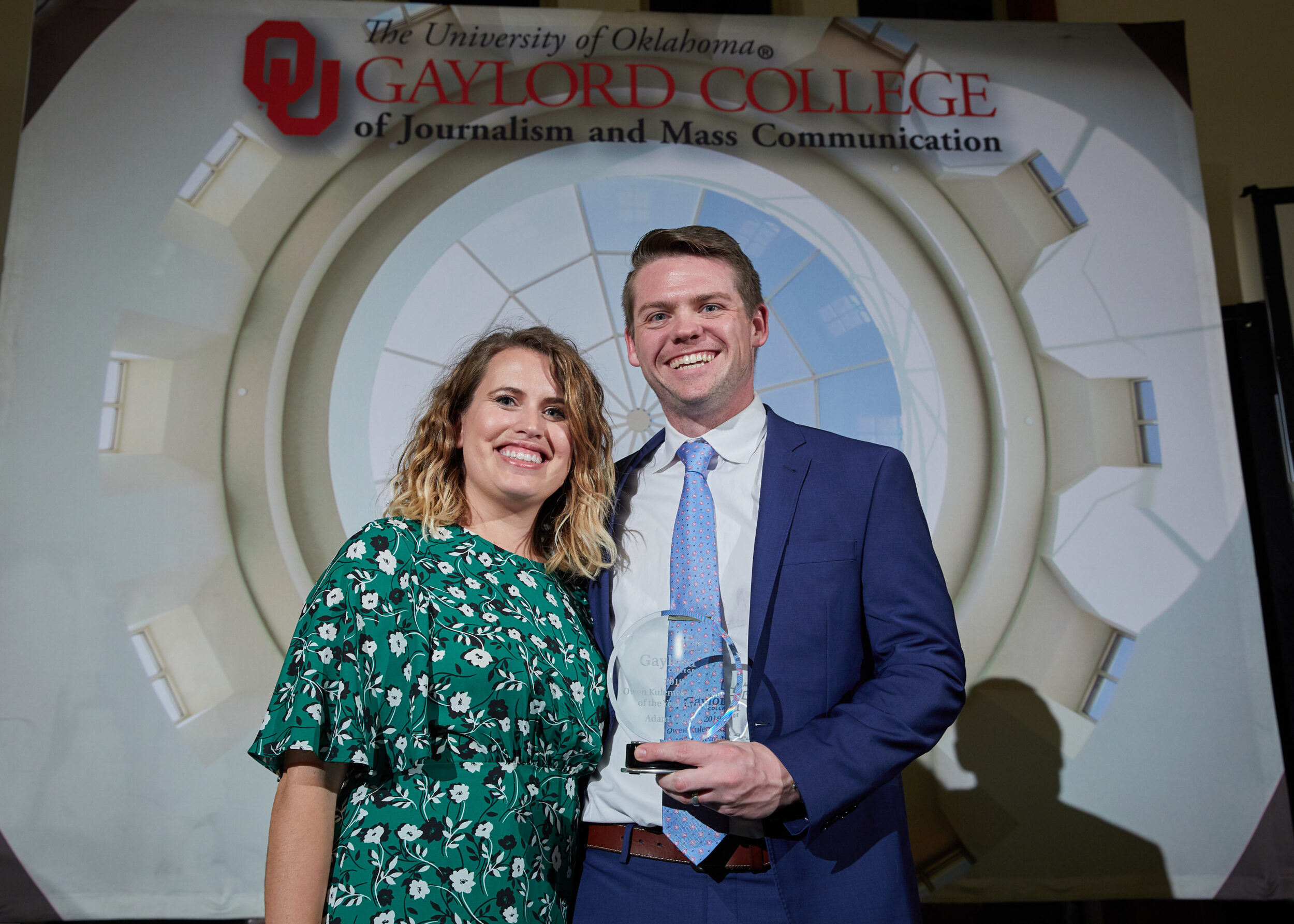
So where to start? Hey, how about this. The students of Gaylord College voted me Teacher of the Year all the way back in February.
THE STUDENTS VOTED ME TEACHER OF THE YEAR IS THIS REAL LIFE https://t.co/4MoqQToVAp
— Adam Croom (Not Actively Checking Account) (@acroom) February 29, 2020
Why wait so long to record this one on the blog even when I’ve posted a handful of times since February? Probably timing of the award more than anything else. On the day of the ceremony, an on-campus hunger strike/sit-in had literally ended hours before. A week later, I would get a phone call asking me to plan for a potential two week transition to remote learning after Spring Break, and, well, we all know how that ended. Thus, I wasn’t allowing myself much time to reflect on how much the award meant to me. I can’t say I’m fully there still but I do want to take the opportunity now to document it before the year ends. After all, this blog has been nothing if not a place for me to reflect on my teaching practices over the past seven years. In a year like 2020, no one wants to celebrate victories–big or small–but I’m going to give it my best shot.
First, this award means a lot to me for two reasons. The first reason is that the winner is picked 100% by students. The finalists are narrowed down by teaching evaluations and then a vote is held amongst the student body.
I didn’t even know I was a finalist until a student came to my office to congratulate me. I was floored. Just to be named a finalist was plenty enough recognition for me. A couple years ago I was having a conversation with a colleague of mine and telling her, frustratingly, how hard it is to receive feedback on how well you are doing in the classroom. I told her this story that was relayed to me by our development officer, who said she was talking to a recent alum who had graduated a few years back. The alum was raving to them about how much he enjoyed having me a professor (at least this was the story relayed to me). Unfortunately, all I remembered about this student was that he quietly did his work. I didn’t have any negative memories of him, but he also wasn’t one of those students who we kept in touch after the semester either. It amazed me that my class was his favorite and that, heck, he even remembered me. Any way, I was telling my colleague that I had come to realize that part of being a teacher is acknowledging that very few students realize the impact you’ve made on them until years after they graduated. It’s possible that I’m projecting a bit here because I know that as a student I only came to have a real appreciation for my instructors years later. Now, I could tell you multiple classes where I held on to specific lessons or small pieces of advice they likely made in passing, but, of course, it’s nearly impossible to know what parts of your education will be most impactful into you can gauge it against life experience.
The point being that, in industry, you become accustom to feedback that is both quicker and more immediately applicable. For example, I was amazed to find out early on in my career as an adjunct that my teaching was never going to be directly evaluated by my peers. As an instructor, your only form of feedback–student or otherwise–are teaching evaluations which are flawed. I pay close attention to those, but I’ve also learned to how to separate the wheat from the chaff in terms of ways that students think the class can be improved. All of this is to say, getting nominated by students was genuinely the kindest and most applicable piece of feedback I have ever received.
The second reason the award meant a lot to me is because was started in remembrance of Owen Kulemeka, a faculty member who passed away suddenly in the summer 2015. While I didn’t know him personally, I was very familiar with him. We both taught PR Pubs and he was very well liked by his students. He was known by his students and colleagues alike for being caring, empathetic, and full of joy. Owen’s students loved Owen, and there isn’t much more you can ask for there. He was cared for so much that his office remained untouched for many years as College grieved the loss. To say it is an honor to carry the torch would be a grave understatement.
A couple months after hearing about the nomination, I received an invitation to the College’s annual awards banquet. I wasn’t sure if all of the finalists were invited or if it was simply the winner, but I knew that not all faculty were invited to attend due to limited space, so I started to mentally prepare for the possibility that I had won even if I refused to fully acknowledge it. On the day of the event, in a panic quickly jotted down a potential acceptance speech just in case (and not evening knowing if I was allowed one). That evening, I incorrectly thought the event was later than it was due to a calendaring error, so Katie and I went to go get a quick drink before the dinner started. When I received a panicked call from my Dean asking if I was still coming, I realized that chances were good that I had won.
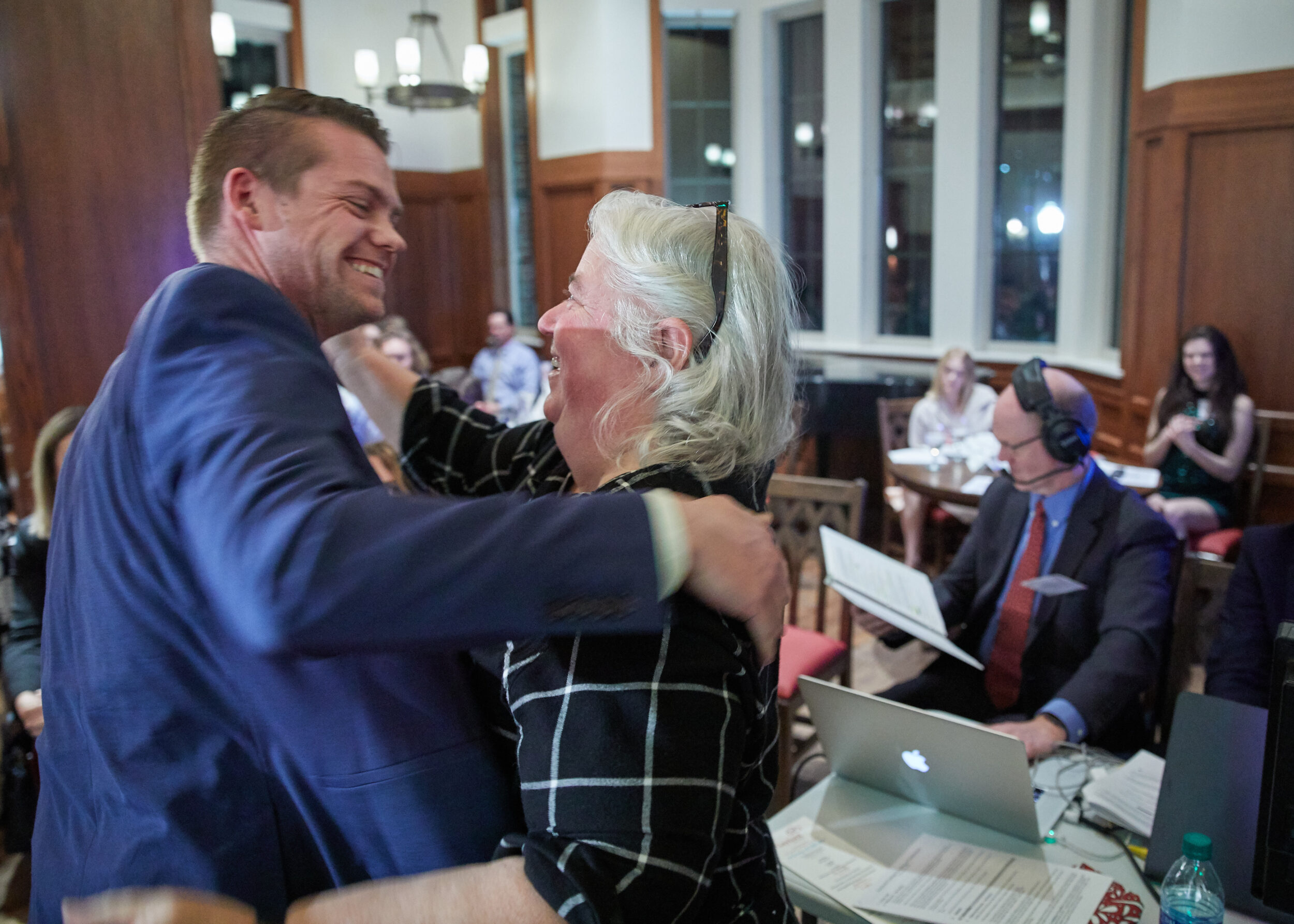
The award was presented to me by the former year’s winner, my wonderful colleague Julie Jones, who was also a personal friend of Owen’s. I gave my hastily written speech. In doing so, I thanked several of my colleagues, many of whom were my former professors:
A fun fact: several of my colleagues were my professors. So I can say with certainty, for a first-generation student from Oklahoma who when he first stepped foot on campus didn’t know much about OU–much less college and the academy–beyond football, I would have never been inspired to be a professor if it wasn’t for my professors. So I would like to thank each of them, individually, in order of which I had them starting:
Thank you Ralph Beliveau, Peter Gade, David Tarpenning, Elanie Steyn, Doyle Yoon, and Lynn Franklin. Meta Carstarphen was my faculty-in-residence. Most of which I work with on a daily basis which is so so special to me. Thanks as well to the late Jim Avery who was willing to hire me as an adjunct in 2013 and Debbie Yount who was willing to support the hire of me as an Assistant Professor in 2017. And, of course, thank you to Owen Kulemeka, for being such an inspiration for all of us.
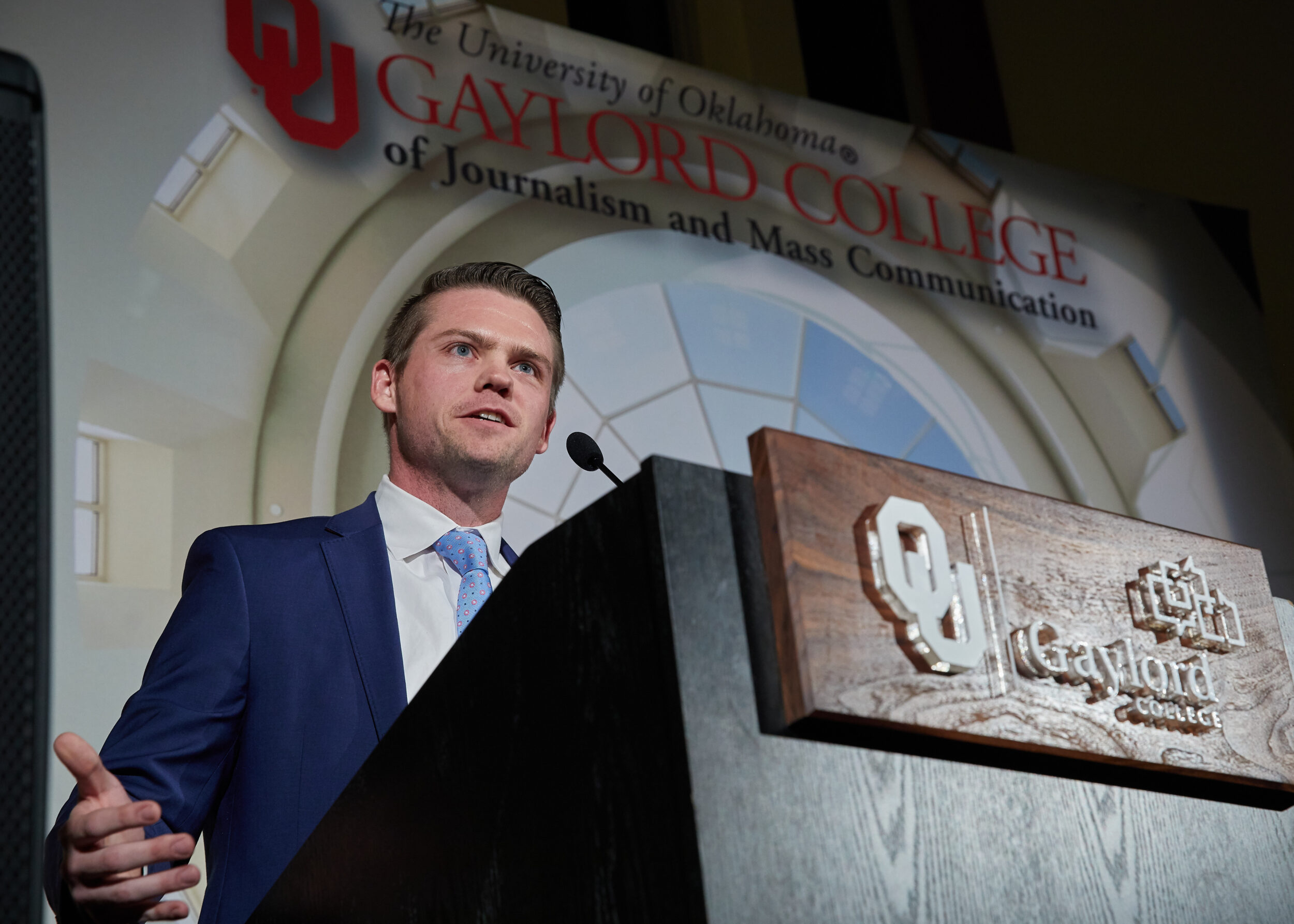
Of course, I also thanked the students, and then I ended the speech by talking about the importance of adjuncts. I started teaching as a passionate alumni who wanted to give back and, being that I was in a room filled with alumni, I wanted to potentially pass along the message about how important adjuncts specifically in our discipline.
Adjuncts are a critical component for instruction in Gaylord because they bring industry knowledge, experience, and expertise into Gaylord Hall, and they often do it while commuting from their 9 to 5.
For the alumni, like myself, in the room, I think the greatest gift you have to give our students is your time. Just like you are doing tonight. Thank you. Yes, we would love you to write a check. Consider this an invitation to write an intellectual check as a guest speaker, presentation judge, or possibly an adjunct.
Looking back at the speech months later is an interesting way of reflecting on what I shared. As a former adjunct, it was clearly weighing heavy on my mind that 1.) adjuncts care a significant portion of the workload and 2.) that they weren’t eligible for this award. With that in mind, I can’t say for certain, but I imagine that this caused me to have a tinge of guilt. I elected that feeling into a call to action for the attendees.
My one regret is that I failed to thank my family–most importantly, my wife. She’s such a support system and my biggest cheerleader. No individual award is earned by an individual person and no one person outside of my parents have had the level of influence on me that she has had on me. I’m not sure how many times I’ll get the opportunity to give an acceptance speech, but in the small chance I am awarded anything ever again, I promise to not forget.
In 2017, I heard some advice which I’ve since held onto. OU had, for the first time in history, cracked the top 100 overall college in U.S. News and World Report’s ranking (it was incidentally stripped two years later). Any way, at the time, our Provost was announcing this news at a meeting I was attending with our Deans (the news wasn’t public yet), and he added something to the effect of, “You always need to put the exact right amount of weight on news like this. Don’t over or under value it.”
This is most true of college rankings, but I still held on to anecdote and have since applied it to a handful of situations. I’m incredibly grateful for this award, but I continue to also tell myself, “That’s a good data point of a positive trajectory. Note that, Croom, but don’t slow down either. Keep swimming.” Even in a year that I would give back, I’ll hang on this one.