I recently gave a talk to a group of our online graduate faculty about teaching and assessing in the age of generative AI. It was a 4 o’clock slot in the middle of the summer, which is the academic equivalent of asking people to help you move on a holiday weekend, and something like forty faculty showed up anyway. Forty people gave up the back half of a summer afternoon to talk about AI and cheating, which tells you roughly how much this is sitting on everyone’s chest right now.
My colleague who convened the session put the whole problem in one sentence before I even started. In a face-to-face class, she said, you can always fall back on the blue book. Online, that’s not a choice. And she’s right, and I think that sentence is worth sitting with, because a lot of the anxiety in higher ed about AI is really just the sound of the blue book going away and not coming back. For online courses it was never there to begin with.
I’ll start with the thing I opened with, which is the least reassuring sentence in my whole deck: no assessment is truly AI-proof. I said it early and on purpose, because I think it’s actually a relief once you accept it. We lean toward the term “AI-resistant” at OUES for a reason. The instant you’re chasing “AI-proof,” you’re chasing a thing that doesn’t exist, and you’ll spend the semester playing a detection game you’re structurally going to lose. Better to admit the ceiling and then design underneath it deliberately.
What the data actually says
I spent the first stretch grounding everyone in numbers, because the numbers are genuinely wild and they change the conversation from “are students using this” to “what are we going to do about the fact that they already are.”
As of 2024, 86% of students report using AI in their studies. 54% use it weekly for coursework. Faculty adoption jumped to 45% in 2024, up from 24% the year before, so faculty are catching up fast but from behind. 74% of AACSB business schools now teach generative AI outright. And the one that I think matters most for anyone writing a syllabus this fall: only 5% of students say they’re fully aware of their own institution’s AI guidelines. That’s not a discipline problem. That’s a communication problem, and it’s ours, not theirs.
The other survey I leaned on was the 2026 EDUCAUSE report on the impact of AI on assessment, which came out in June and which I sat in on a session about. What I love about that data is how split it is. 60% of respondents say they feel a mix of caution and enthusiasm about AI, which is the least clickbait-y and most honest answer a survey has ever produced.

When you ask whether AI, used correctly, can support the purpose of higher education, 92% agree.

When you flip it and ask whether AI is helpful to student learning, most say yes. But when you ask whether it’s detrimental to student learning, the room scatters. Everyone’s experience is different.

My favorite pairing in the whole report is that faculty say AI makes teaching easier and harder at the same time.

And then, almost identically split, respondents say students are using AI to learn and using AI to cheat in roughly equal measure. Something like 16% and 17% on those two.

Same students, same tool, opposite outcomes, and no clean way to tell which is which from the outside. That’s the actual environment. What we have isn’t a crisis with a villain, but rather a genuinely fluid mess where the same behavior is either virtuous or dishonest depending on context the instructor can’t see.
We have an institutional AI teaching policy at OU. It’s good. It was approved in August 2025 and, per the document itself, isn’t up for review again until 2028, which in AI years is roughly the Pleistocene. I reread it a few weeks ago expecting it to feel dated and it mostly holds up, which is a small miracle for anything written about this topic a year ago.
Here’s the detail I pointed out, and I want to be clear I did not point it out as a gotcha. Down in the acknowledgements, the policy discloses that it was drafted with the assistance of ChatGPT.

So the institution used AI to write the AI policy that everyone has now adopted. I don’t think that’s embarrassing, but just an unusually clean snapshot of the world as it now exists. The tool we’re writing rules about is the tool we wrote the rules with. If you’re waiting for a version of this conversation where AI is safely on the other side of the glass from the people making decisions about it, that version isn’t coming.
Two lanes, a stoplight, and a scale
The practical framework I gave them is what I’d call a two-lane model, and I’d rather people remember this than any single tool.

There’s a secure lane and an open lane. The secure lane is for the assessments where you genuinely need to verify that a specific human knows a specific thing with their own brain: closed-book knowledge checks, the multiple-choice and true/false and matching stuff, timed quizzes in Canvas, the foundational verification. It’s real, it has its place, and it also cannot carry the higher-order work. It can’t touch analysis, evaluation, synthesis, or anything that needs a spreadsheet or a coding environment open next to it.
The open lane is everything else, and it’s where I think most of the interesting design work is right now. This is AI-integrated or AI-transparent work that measures process thinking instead of measuring AI-avoidance. Case analyses with the process documented. Iterative drafts with prompt logs and a reflection. Oral components. Personalized scenarios the machine can’t fully resolve because it doesn’t know your specific client or your specific quarter. The open lane requires more from you as the designer: a clear course-level policy, a rubric that rewards reasoning and not just output, and a real willingness to grade AI-assisted work rather than pretend it away.
For giving students clarity, there are a couple of vocabularies floating around OU’s Center for Faculty Excellence that I like. The simplest is the stoplight: red means no AI, yellow means regulated with disclosure, green means go for it as long as you cite and document.

The more granular one is the AI Assessment Scale, five levels running from No AI, to AI Exploration (brainstorm with it, write the thing yourself), to AI Assistance (bounded tasks like grammar), to AI Collaboration (co-author it, but log and reflect), to AI Co-pilot (full integration, and you’re graded on your judgment and oversight, not on production). The value of any of these isn’t the specific labels. It’s that they force the policy down to the assignment level, where students actually read it, instead of the handbook level, where they don’t.
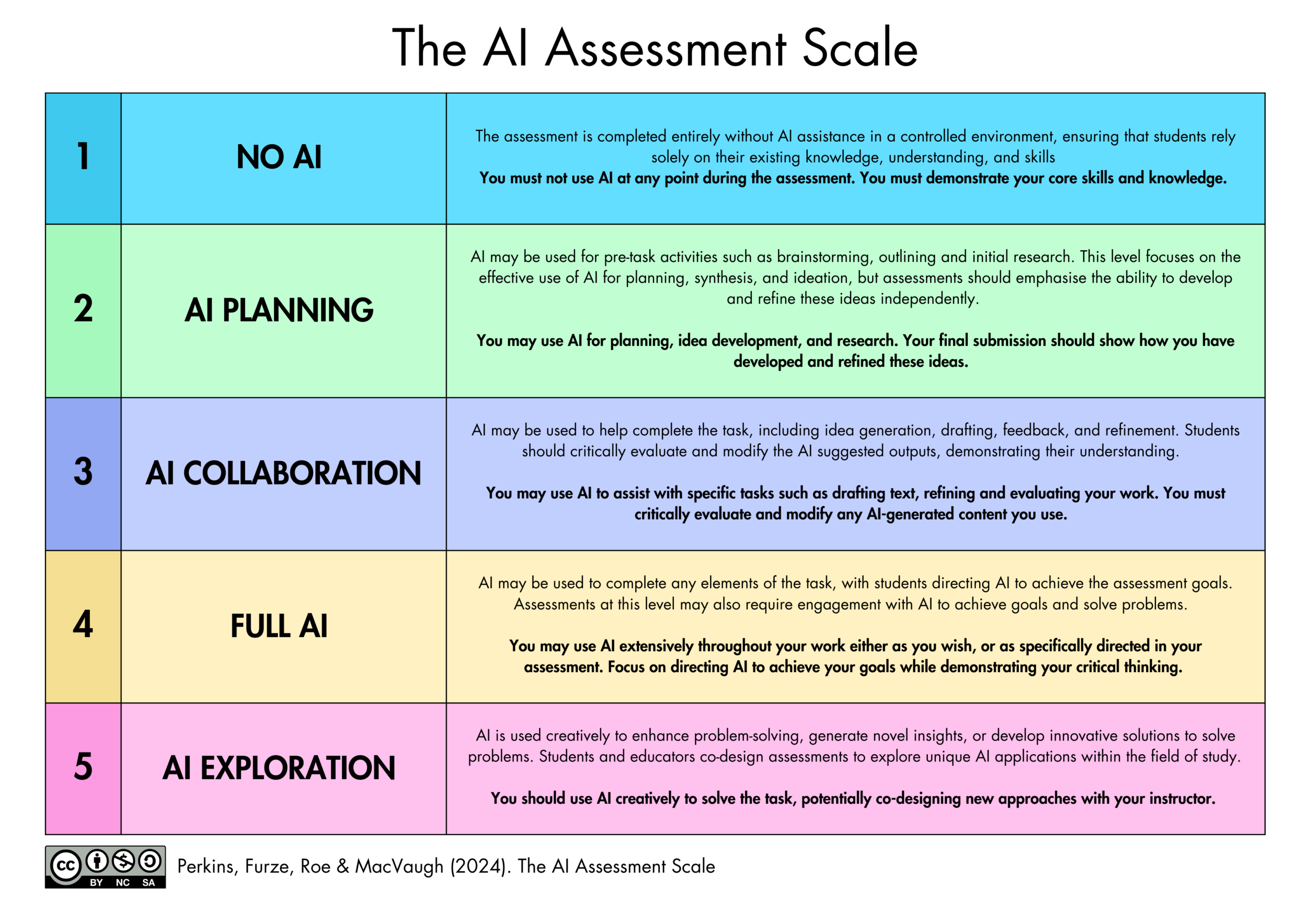
Because here’s the thing that follows directly from that 5% number: the student handbook doesn’t always change behavior, but the line at the top of the assignment does. I’ve watched this myself. Students will say, with total sincerity, “I didn’t know I couldn’t use it for this one.” A course-wide “no AI” banner reads to a student like a terms-of-service agreement, which is to say it doesn’t get read. A specific line on a specific assignment gets read. I even threw in a small delightful side effect: some of the in-browser AI agents, like ChatGPT’s Atlas browser, will actually balk when the assignment text explicitly says not to use them. You can bully the tool into complying, but the explicit instruction is a speed bump even for the automated stuff.
I made one more claim in this stretch that I’ll stand behind: the rubric is the real AI defense. Not the detector. The rubric. If your rubric rewards a specific student’s actual sources, their argument structure, their revision history, the relationship they have with you as the instructor, then AI can’t fabricate that, because that history never happened. The integrity is built into the shape of the assignment, not bolted on afterward with software.
On detectors, briefly
I don’t trust AI detectors and neither does OU. Tools like Turnitin’s AI detection or GPTZero will hand you a probability of AI authorship, and that probability is easy to circumvent, prone to false positives and false negatives, and disproportionately likely to flag non-native English writers. I pulled the language straight from our policy: OU’s Office of Academic Integrity does not consider detector results as factual evidence in misconduct cases, and faculty shouldn’t lean on them as a primary or sole source of evidence. If you take one operational thing away from all of this, let it be that. The detector is not the witness you want to build a case on.
I did spend real time on Respondus LockDown Browser and Monitor, because it’s our supported proctoring tool and it has genuine uses in the secure lane. It’s great for locked-down Canvas quizzes. It’s bad the moment a student needs Excel or SPSS or a coding environment, because the whole point of it is that they can’t leave the browser. It’s rough on Chromebooks. There’s a new second-camera feature as of April that lets a student’s phone serve as a second angle on the workspace, which I think is a real improvement, and I said so, while also naming the obvious cost: it assumes every student has a second device and a private room, and neither of those is a safe assumption. Proctoring is anxiety-inducing even when it works. I’ve gotten the “my little brother walked in, I hope that’s okay” emails. I told them what I believe, which is that you turn this on for the handful of high-stakes assessments where a secure baseline genuinely matters, and you leave it off everything else.
This is the part I actually want to write down, because my slides were the setup and the faculty were the payoff. Here’s the pattern I didn’t fully see until I was in the room. The faculty who sounded tired were the ones still trying to catch it. The faculty who sounded relieved were the ones who had stopped trying to catch it and started designing around it. And every one of their solutions was some version of “make the process visible” or “make them explain it to my face.”
One instructor described building what she calls an AI lab into the front of a weekly assignment. Her logic was blunt and I loved it: I can’t beat student motivation, so if they’re going to use it, I’m going to assume they’re going to use it and scaffold them into using it well. She has them show the prompting and reflect on how the prompting evolved and shaped their thinking. The reflection is the assignment. She’s not policing the tool, she’s teaching a skill that happens to also be evidence.
A capstone instructor described a semester-long team project with a three-pass structure that I thought was close to ideal. First pass: do it longhand, the way you always would, and see what you get. Second pass: here are some AI tools, redo it. Third pass: compare the two, tell me where your own thinking was limited, tell me where the AI’s output was limited, and then give me your best answer using both. He said the quality of the research went up and, more interesting to me, the breadth of what students considered went up, because the AI surfaced angles they hadn’t thought of. He’s grading the comparison, which is the one thing a chatbot can’t hand you.
An MIS instructor shared a whole toolkit: multiple drop-downs that resist copy-paste, short-answer questions that require a real textbook citation students have to actually go read, and for the coding classes, where AI can now write better code than most students, a two-minute recorded code review where the student explains why their code does what it does. That video is the assessment. AI can write the code. It can’t sit in the chair and defend it in the student’s own voice for two minutes.
A colleague who grew up in a part of the world where exams were oral, said she’d spent her early teaching career thinking oral exams were horrible and avoiding them. Now she wants to bring them back. Her plan is a qualifying verbal component for everyone, not a pick-and-choose interrogation of the students she suspects, but a blanket “you’ll pull one question and explain to me how you did it.” She kept asking, a little tentatively, whether she was even allowed to do that. And the answer from the group was yes, obviously, as long as it’s in the syllabus up front and framed as a graded component rather than a trap.
The most future-proof assessment idea in a room full of faculty worried about the most advanced technology any of us have ever taught alongside was the oral examination. A form so old it predates the printing press, let alone the blue book. Socrates would recognize it. And it’s suddenly, quietly, the most AI-resistant thing on the table, because spontaneous verbal reasoning in front of another human is the one artifact a student can’t outsource and paste.
You see it everywhere once you notice it. The video defense. The code review. The prompt log plus reflection. The Google Doc where I can watch the paper get built edit by edit instead of arriving fully formed from a chatbot. Requiring the specific, the personal, the local: a real negotiation you were part of, a decision your own organization made last quarter, an event you actually attended. I showed a couple of examples of exactly this, a graduate assignment where students had to sign up for and attend a real trade association event and then discuss it, and a course where a faculty member swapped a traditional interview paper for a 15-to-30-minute podcast the students had to produce, guest and all. Every one of these works for the same underlying reason. It reintroduces a witness. It puts a human, or a process, or a piece of situated reality back into the loop that the machine can’t fully stand in for.
None of it is proof. I said that at the start. There is no assignment I can hand you that a sufficiently determined student can’t get a machine to help with. What there is, instead, is a shift in what you’re even trying to do. You stop trying to prove a negative (that no AI touched this) and start trying to make the AI beside the point (because the thing being graded is the student’s reasoning, their process, their voice, their situated judgment, and those don’t come out of a prompt).
I’ve done versions of this talk a couple times now. Both times, I’ve come into that room to hand people frameworks and anticipated that I would be dodging tomatoes getting thrown at me. Instead, I left both times thinking the frameworks were the least valuable thing that happened. The valuable thing was forty people who’d each been fighting this quietly in their own courses discovering that they’d independently arrived at the same answer, which is older than all of us: if you want to know whether someone learned something, make them show you. Watch the work happen. Ask them to explain it out loud. We built an entire apparatus of remote, automated, at-scale assessment over the last two decades, and the most durable response to AI might just be remembering what we gave up to build it.
I don’t have this fully worked out, and neither does anyone else, and that’s fine. Like I told the room, the policy on the books won’t be reviewed until 2028 and the world will turn over several times before then. We’re going to be sitting with a question rather than an answer for a while. But if the question is “how do you assess honestly in a world where the machine can do the deliverable,” I think we spent a summer afternoon quietly agreeing on at least the shape of the answer. Make the process visible. Put a human back in the loop. And stop grading the artifact when what you actually care about is the mind that made it.
Featured image: Photo by Erik Mclean from Pexels